
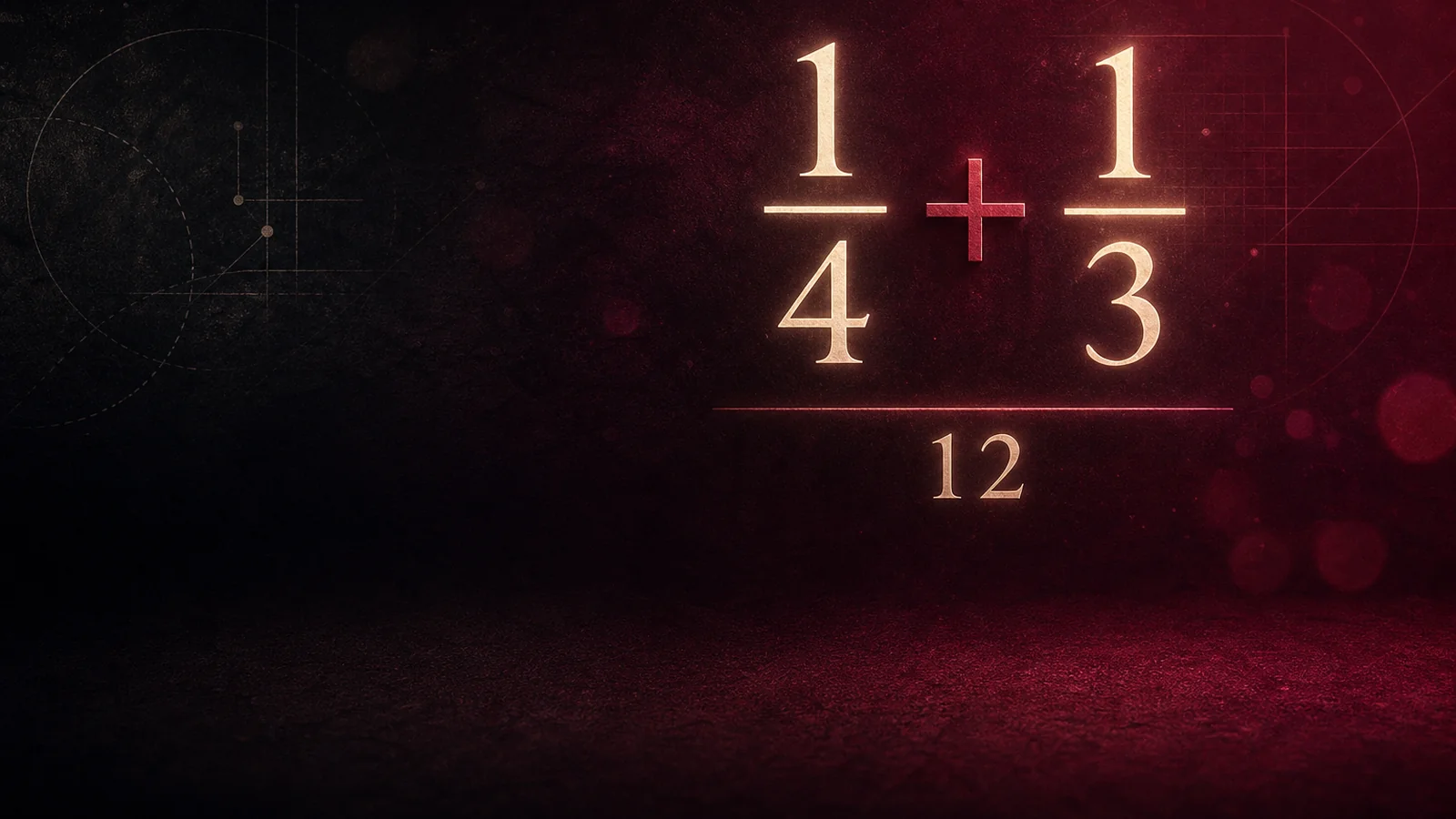
Quick answer
Fraction addition finds the total of two fractional amounts. You add numerators only after both fractions refer to the same denominator, or after you rewrite them as equivalent fractions that do.
Formula
- Like: a/b + c/b = (a + c)/b
- Unlike: find LCD, scale, then add numerators
- Mixed: convert to improper form first
Introduction
Students usually meet fraction addition in two stages. First come like fractions, where denominators already match and you only add the top numbers. Soon after, unlike denominators appear, and the work shifts to finding a common denominator before you add.
The symbols look small, but the idea is about pieces of a whole. A denominator tells you how many equal parts make one whole. A numerator tells you how many of those parts you have. Addition only makes sense when both fractions count the same size piece.
If you already know the definition and want a full procedure next, the how to add fractions walkthrough follows the same steps as the homepage tool.
Definition and meaning
Fraction addition answers a simple question: how much do I have altogether? You might start with 1/4 of a pizza and add another 2/3 of a different pizza. Before you can combine those amounts, both must be expressed with the same slice size.
Like fractions share a denominator. Example: 2/7 and 3/7 both count sevenths, so 2/7 + 3/7 = 5/7. Unlike fractions count different piece sizes, such as fourths and thirds. You rename one or both fractions using equivalent forms before you add.
Mixed numbers combine a whole amount and a fraction, like 2 1/3. Treat them as single fractions by converting to improper form. That step prevents a common mistake where students add whole parts and fractional parts separately without aligning denominators.
Homework often moves quickly from like fractions to unlike denominators; our adding fractions formula page shows the compact rule teachers use for that step.
Core idea behind the rules
- Same denominator → add numerators, keep denominator
- Different denominators → LCD or formula (ad+bc)/(bd)
- After adding → simplify with GCF
The denominator is the unit. You would not add inches to centimeters without converting first. Fractions work the same way: convert to a shared unit, then combine the counts.
Teachers often introduce the least common denominator because it keeps intermediate numbers smaller than multiplying denominators blindly. Both approaches are valid when you simplify the final answer.
Step-by-step overview
- Identify like or unlike denominators If denominators match, add numerators and simplify. If not, plan a common denominator step before you add tops.
- Rename with equivalent fractions Multiply numerator and denominator by the same nonzero number to change form without changing value. The LCD is the smallest shared denominator.
- Add numerators and keep the denominator Once pieces match, addition looks like whole-number addition on the top only.
- Simplify and choose a final form Reduce with the GCF. Write a mixed number if the problem asks for it or if that form is easier to read.
Example: 2/9 + 5/9 (like denominators)
Both fractions count ninths, so add numerators: 2 + 5 = 7. The denominator stays 9. The sum is 7/9.
7 and 9 share no factor greater than 1, so the answer is already in lowest terms. No extra simplification is needed.
For unlike denominators, the process takes longer but follows the same logic. Try 1/4 + 2/3 on the homepage calculator and read the work line to see scaling to twelfths.