
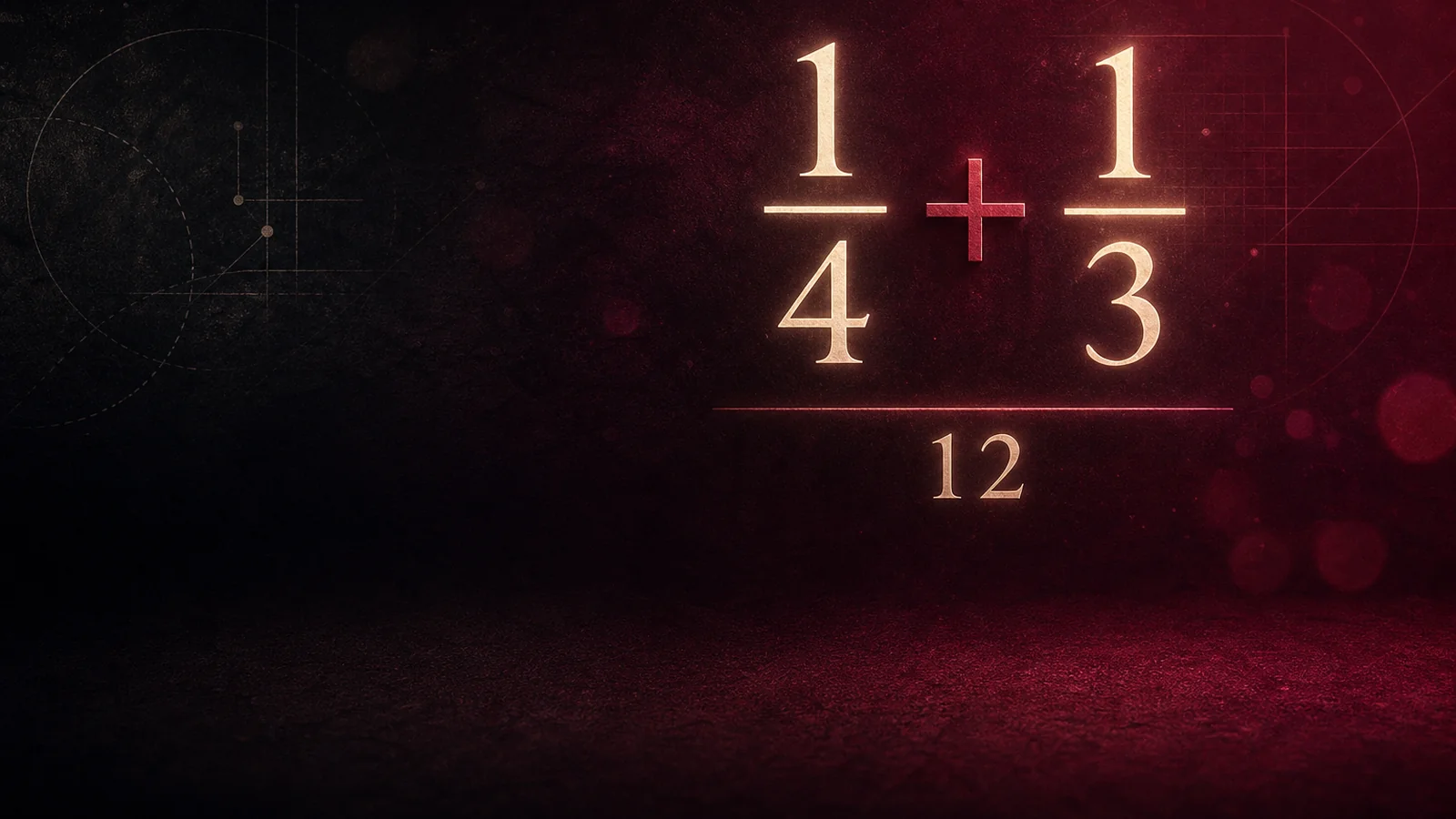
Quick answer
For a/b + c/d with b ≠ 0 and d ≠ 0, the sum is (ad + bc)/(bd). Simplify by dividing numerator and denominator by their GCF, or use the LCD method for smaller intermediate values.
Formula
- a/b + c/d = (ad + bc)/(bd)
- LCD: L = lcm(b, d), add scaled numerators over L
- Reduce: divide top and bottom by gcd
Introduction
Textbooks present two related tools: multiply denominators to get a common denominator, or find the least common denominator (LCD) first. They agree; LCD often uses smaller numbers.
The product rule is fast to write down. The LCD method often keeps numerators smaller, which matters on timed tests and long homework sets.
After you add, treat reduction as part of the answer; simplifying fractions after addition explains how to finish in lowest terms.
Why the formula works
The expression (ad + bc)/(bd) comes from rewriting a/b as ad/bd and c/d as bc/bd. Those are equivalent fractions with the same denominator bd, so you add numerators ad and bc.
The LCD version uses the smallest shared denominator L instead of bd when possible. For 1/4 + 2/3, bd = 12 and lcm(4, 3) is also 12, so both paths coincide. For 1/6 + 1/4, lcm is 12 while bd is 24, and the LCD path is cleaner.
When lcm is awkward to spot by eye, listing multiples still works, and the adding fractions with different denominators guide walks through that renaming process in order.
Formula breakdown
- Cross products: ad and bc
- Denominator product: bd (or LCD L)
- Final: divide by gcd(numerator, denominator)
Example: 3/5 + 1/2 gives (3×2 + 1×5)/(5×2) = 11/10. As a mixed number, 11/10 = 1 1/10.
Example with LCD: 5/6 + 1/4. lcm(6, 4) = 12. Scale to 10/12 + 3/12 = 13/12 = 1 1/12. Same value as using bd = 24, but smaller numbers along the way.
Using the formula on paper
- Write improper fractions Convert mixed numbers to (W×d + n)/d before you apply the rule.
- Choose LCD or product denominator Use lcm when you want smaller work; use bd when you need a quick template.
- Compute the sum numerator Either ad + bc over bd, or scaled numerators over L.
- Reduce and convert form Apply GCF reduction. Write a mixed number if the result is improper and the context calls for it.
Example: 3/5 + 1/2
Apply the formula: (3×2 + 1×5)/(5×2) = (6 + 5)/10 = 11/10.
11 and 10 share gcd 1, so 11/10 is already simplified as an improper fraction. As a mixed number: 1 1/10.
Enter 3/5 and 1/2 in the calculator to see the common denominator step and reduced output match your paper.