
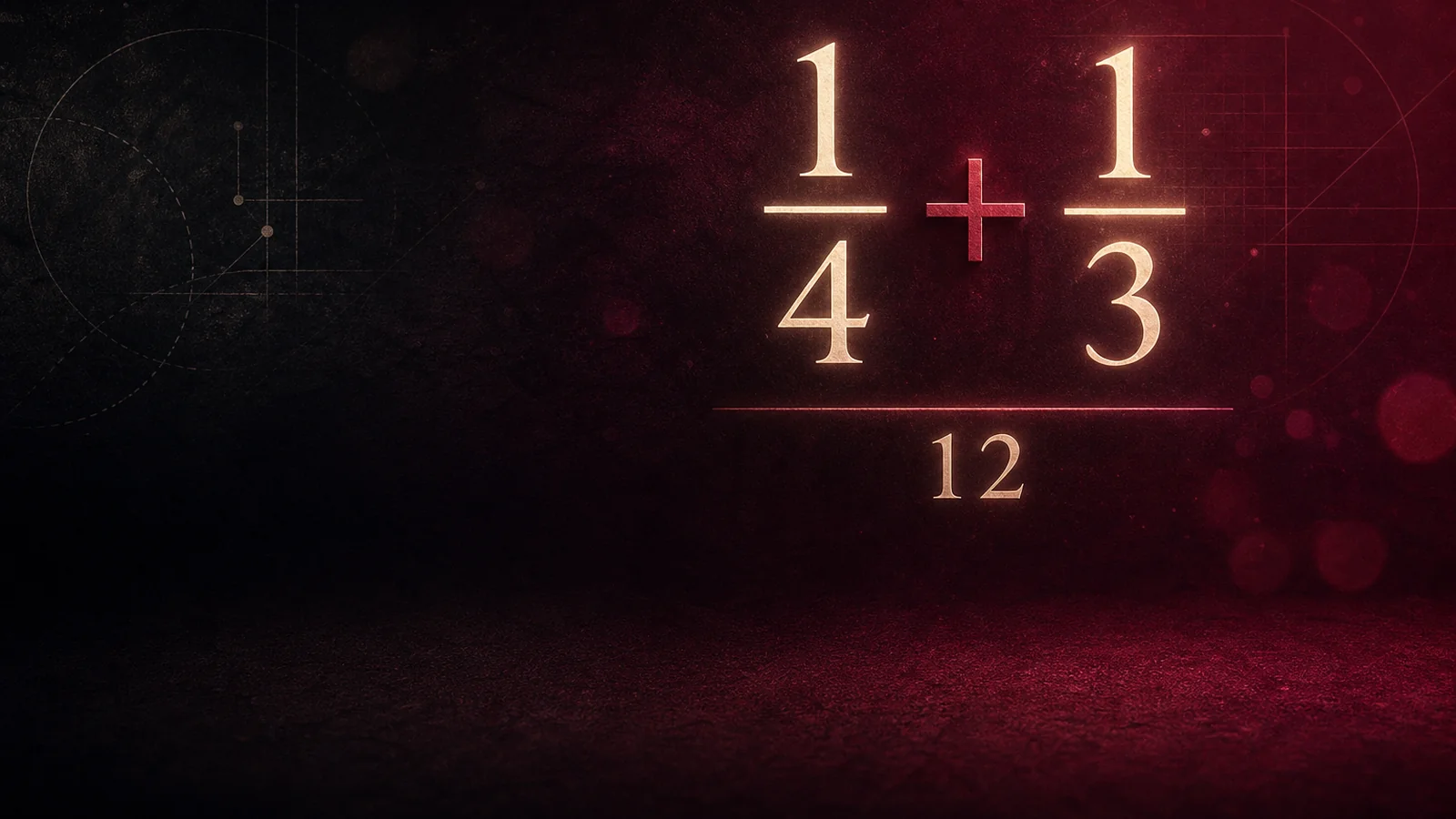
Quick answer
After adding, divide numerator and denominator by their greatest common factor (GCF). Convert improper fractions to mixed numbers when the problem calls for that form.
Formula
- gcd(n, d) = g → (n/g)/(d/g)
- If n > d, optional mixed conversion
- gcd = 1 means lowest terms
Introduction
Teachers mark unsimplified fractions even when the numeric value is right. Simplification is part of presenting a complete answer.
Reduction also makes the next step easier if you chain several additions in one problem.
For full setups that end in a gcd step, skim adding fractions examples and simplify each answer as if it were a test requirement.
Greatest common factor
The GCF is the largest whole number that divides both numerator and denominator without a remainder.
Example: 8/12 simplifies by dividing by gcd(8, 12) = 4 to get 2/3.
Reduction assumes you already combined numerators over a shared denominator, so review the adding fractions formula if the sum itself is still unclear.
Improper to mixed
- 7/4 = 1 3/4
- Divide: quotient = whole, remainder = numerator
Simplification and mixed conversion are related but not identical. Simplify first so the fractional part of a mixed number is proper when required.
Verification: cross multiply after simplifying. If a/b is lowest terms, then a×d ≠ b×c for any smaller positive c/d equivalent.
After you add
- Finish the addition Complete LCD work and write the unreduced sum if that helps you see common factors.
- Find gcd(n, d) Use factors, prime factorization, or the Euclidean algorithm.
- Divide and state the final form Write lowest terms or a mixed number per instructions.
Example: 3/10 + 1/10
Add: 4/10. gcd(4, 10) = 2.
Divide: 4/10 = 2/5. That is the answer in lowest terms.
Compare with the calculator: it should show 2/5 directly because reduction is built in.