
Quick answer
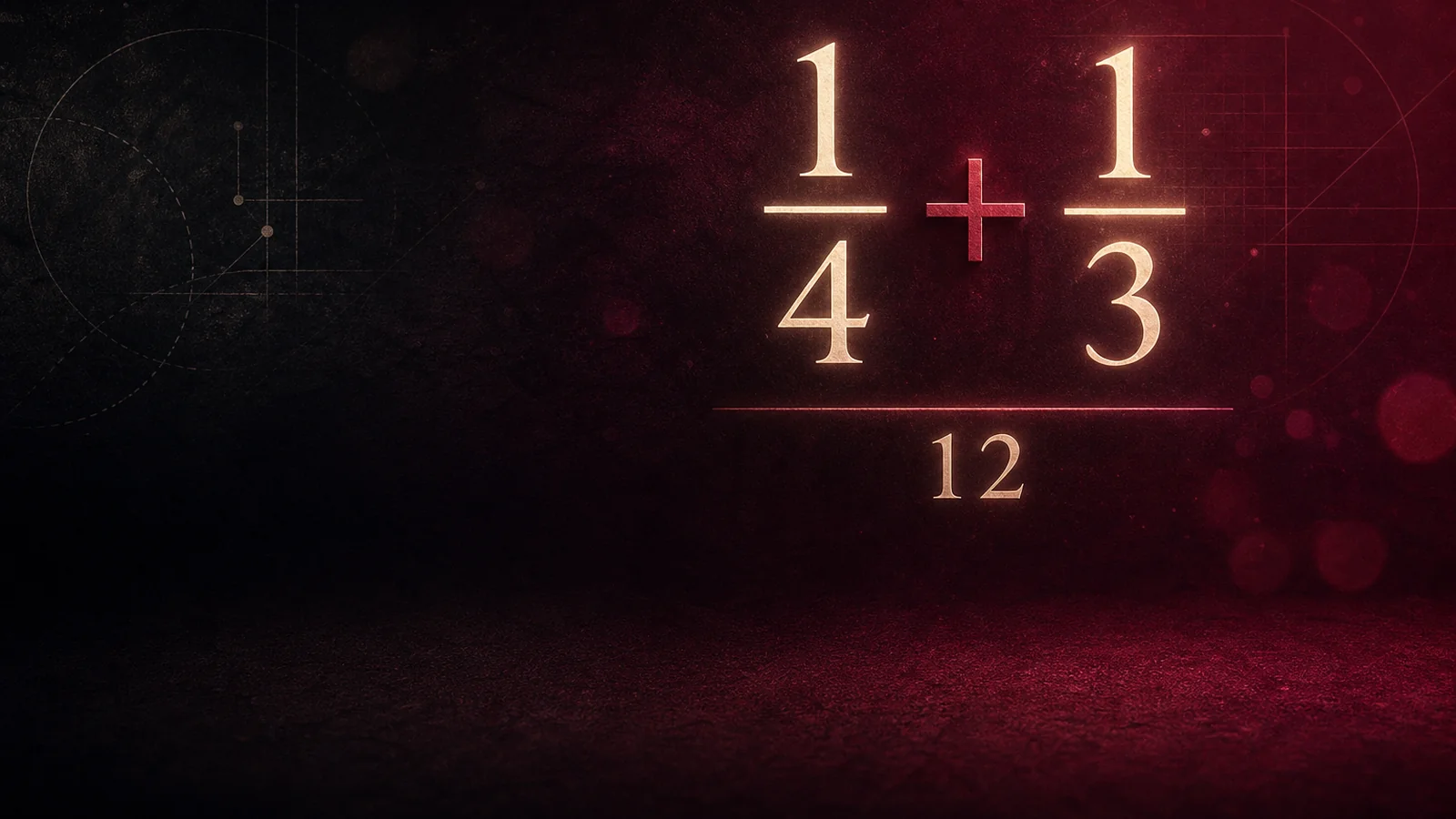
Find the least common denominator (LCD), rewrite each fraction with that denominator, add numerators, then simplify the result.
Formula
- L = lcm(b, d)
- a/b → (a×L/b)/L
- Sum = (scaled a + scaled c)/L
Introduction
Different denominators mean different unit sizes. You are adding thirds to fourths, not the same kind of slice yet.
Equivalent fractions change appearance without changing value. That is the tool that makes unlike denominators manageable.
When you want several finished sums to compare, work through adding fractions examples after you practice lcm on this page.
LCD calculation
The LCD is the least common multiple of the denominators. It is the smallest denominator both fractions can share without changing value.
List multiples: for 4 and 6, multiples of 4 are 4, 8, 12, ... and multiples of 6 are 6, 12, 18, ..., so lcm is 12.
If you prefer a single line of algebra before you scale, the adding fractions formula writes the sum as (ad + bc)/(bd) before you reduce.
Denominator conversion
- Multiply top and bottom by the same factor
- 1/3 = 2/6 = 3/9
- Check value with cross multiplication
To convert 1/4 to twelfths, multiply by 3/3 to get 3/12. The factor 3/3 equals 1, so the value stays the same.
After both fractions share the LCD, addition is the easy part: add numerators, keep the denominator.
LCD method steps
- Find lcm of denominators That lcm is your LCD unless the problem specifies another common denominator.
- Scale each fraction Multiply numerator and denominator so the denominator equals the LCD.
- Add and reduce Combine numerators over the LCD, then apply GCF simplification.
Example: 5/6 + 1/4
lcm(6, 4) = 12. Scale: 5/6 = 10/12 and 1/4 = 3/12.
Add: 10/12 + 3/12 = 13/12. As a mixed number: 1 1/12.
gcd(13, 12) = 1, so 13/12 is already reduced. Test the same pair in the calculator.