
Quick answer
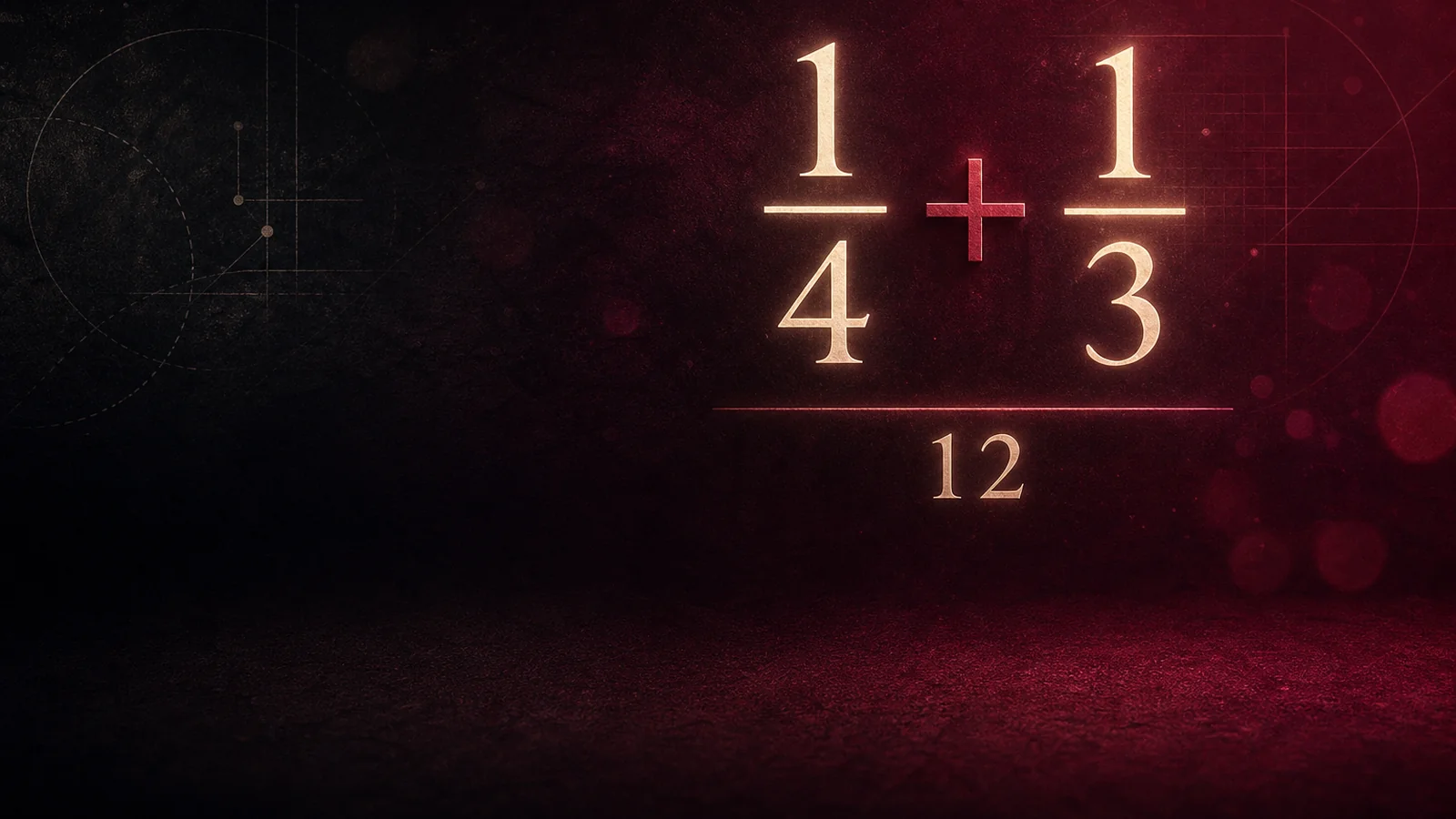
Convert mixed numbers if needed, find a common denominator (usually the LCD), rewrite both fractions, add numerators, keep the denominator, then simplify.
Formula
- Mixed → (W×d + n)/d
- LCD → scale both fractions
- Sum → reduce with GCF
Introduction
Fraction addition shows up in recipes, probability, survey data, and every grade level that introduces rational numbers. The procedure is stable even when the numbers change.
Manual steps build understanding. A calculator pass confirms that your LCD and scaling were correct. Both together beat guessing when homework is due.
When your problem includes a whole number, read adding mixed fractions first so you convert before you scale denominators.
What adding fractions really does
You are counting how many same-sized parts you have in total. The denominator names the part size. The numerator counts how many of those parts you hold.
Unlike denominators mean the fractions are not ready to add yet. Equivalent fractions let you rename 1/2 as 2/4 or 3/6 without changing value, so you can line up denominators.
Once the method feels familiar, test yourself with the adding fractions examples article, which mixes like denominators, unlike denominators, and a cup-measurement problem.
Core rules to remember
- Never add denominators in a sum like 1/2 + 1/3
- Improper: W n/d = (W×d + n)/d
- Check: simplify at the end
A common wrong answer for 1/2 + 1/3 is 2/5 from adding tops and bottoms. The correct path uses lcd 6: 3/6 + 2/6 = 5/6.
Carry the same steps to three or more fractions by finding an LCD for all denominators, or by adding two fractions and then adding the result to the next.
Step-by-step method
- Convert mixed numbers to improper fractions Multiply the whole by the denominator, add the numerator, place over the same denominator.
- Find the least common denominator Use multiples or prime factors to get lcm(b, d). That is your target denominator.
- Build equivalent fractions Scale each fraction so its denominator equals the LCD. Adjust numerators accordingly.
- Add numerators and simplify Keep the LCD as denominator. Reduce with GCF. Convert to mixed form if needed.
Example: 2/5 + 1/3
Denominators 5 and 3. lcm(5, 3) = 15.
Scale: 2/5 = 6/15 and 1/3 = 5/15. Add: 6/15 + 5/15 = 11/15.
gcd(11, 15) = 1, so 11/15 is final. Enter the same values in the calculator and compare the work line.